Part 135Safety management (SMS)14 CFR Part 5
Your SMS, ready before May 28, 2027.
A Part 5 safety management system built into the system you already schedule and fly with: a safety policy your accountable executive signs in GoFBO, confidential reporting, a hazard register on a risk matrix, investigations and corrective actions, SMS training records safety bulletins, audits and change reviews, and the declaration letter when you're ready. Every step kept in records an inspector can follow.
All four pillars of Part 5.
Each one mapped to the sections of 14 CFR Part 5 it covers.
Safety policy
What you're committing to, who is accountable, and what happens in an emergency.
- Safety policy with every part 5.21 asks for, from a starting draft
- Signed by your accountable executive in GoFBO, with versions kept
- Everyone reads it and marks it read; you see who hasn't
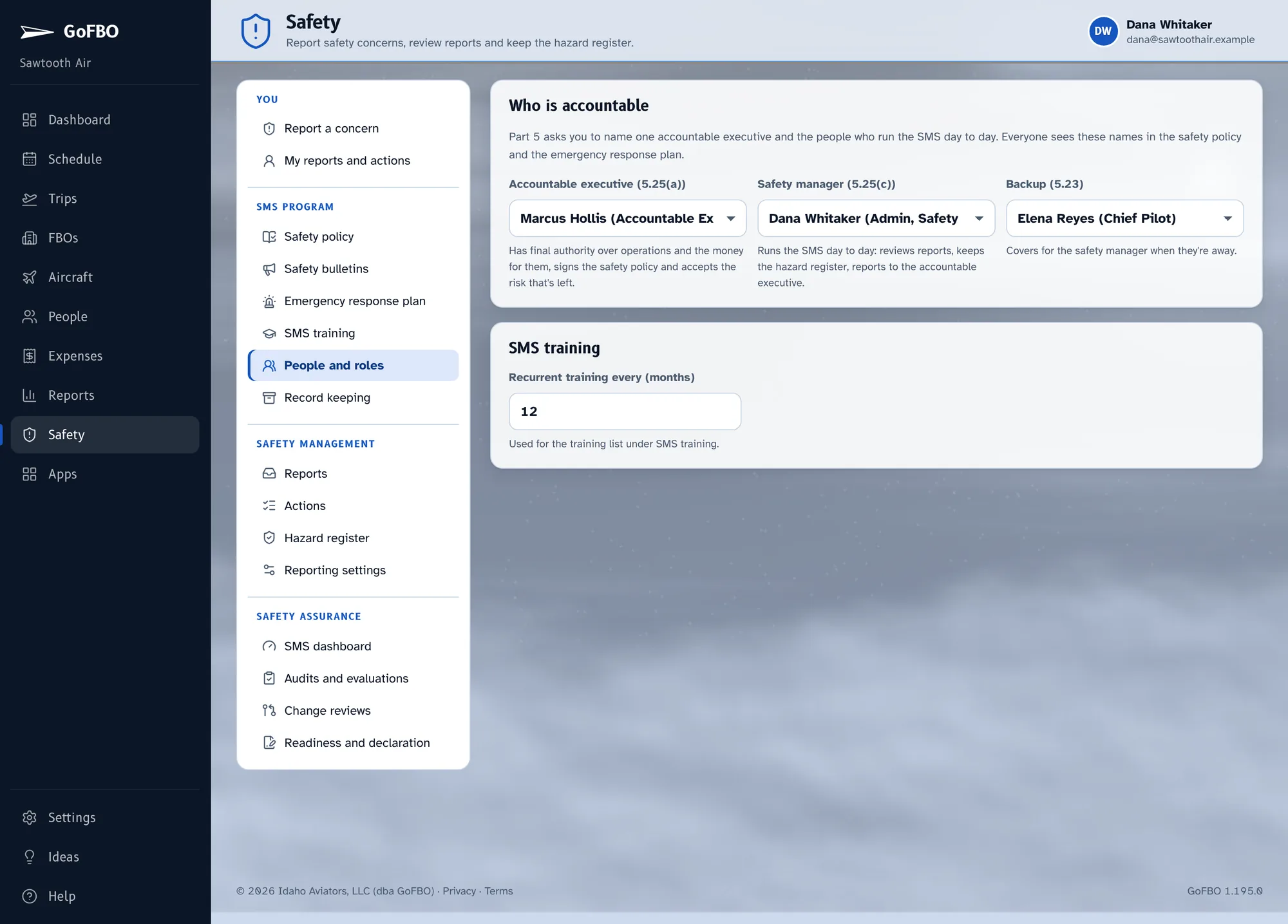
- Accountable executive, safety manager and backup named
- Emergency response plan with the contact list
Safety risk management
Find the hazards, rate the risk, put controls in place and accept what's left at the right level.
- Hazard register with a 5×5 likelihood and severity matrix
- Risk before and after controls; High risk accepted only by an Admin
- Controls with owners, and review dates
- Management of change for new aircraft, bases, routes, procedures and people
Safety assurance
Know whether the controls work: reports, investigations, corrective action and the numbers over time.
- Confidential employee reporting (5.71(a)(7)), and anonymous if you allow it
- A no-sign-in link for line service and contractors
- Investigations with findings, root cause and corrective actions
- Reports started from FRATs, duty, overdue flights and MEL deferrals
- Safety objectives measured from your records, on an SMS dashboard
- Internal audits and the yearly SMS evaluation, with findings
Safety promotion
Train people for their part, and tell everyone what was learned.
- SMS training records, initial and recurrent, with due dates
- Safety bulletins and lessons learned, by email or text
- Who has read each bulletin, and who hasn't
- Feedback to the person who reported
The reports start where the risk shows up.
A standalone SMS waits for someone to remember to log in and write it up. In GoFBO the trip, the aircraft and the details are already there, so the report is one click from the place the problem appeared.
How it works.
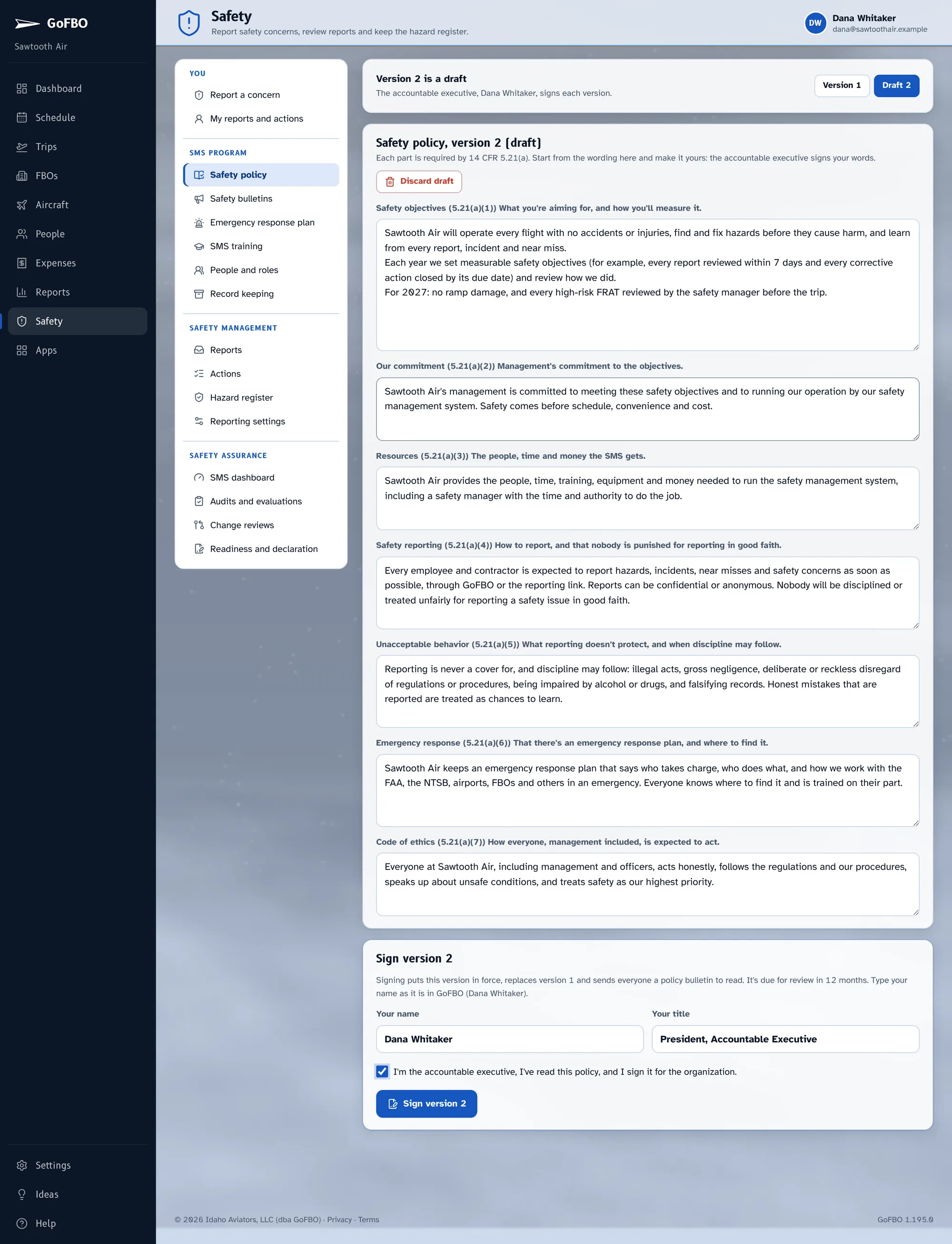
Write and sign the safety policy
Start from GoFBO's draft of every part 14 CFR 5.21 asks for, edit it into your own words, and your accountable executive signs it in GoFBO by typing their name and title.
- Each signed version is kept, with a signature check printed on it
- Due for review every 12 months
- Signing sends everyone a policy bulletin to read
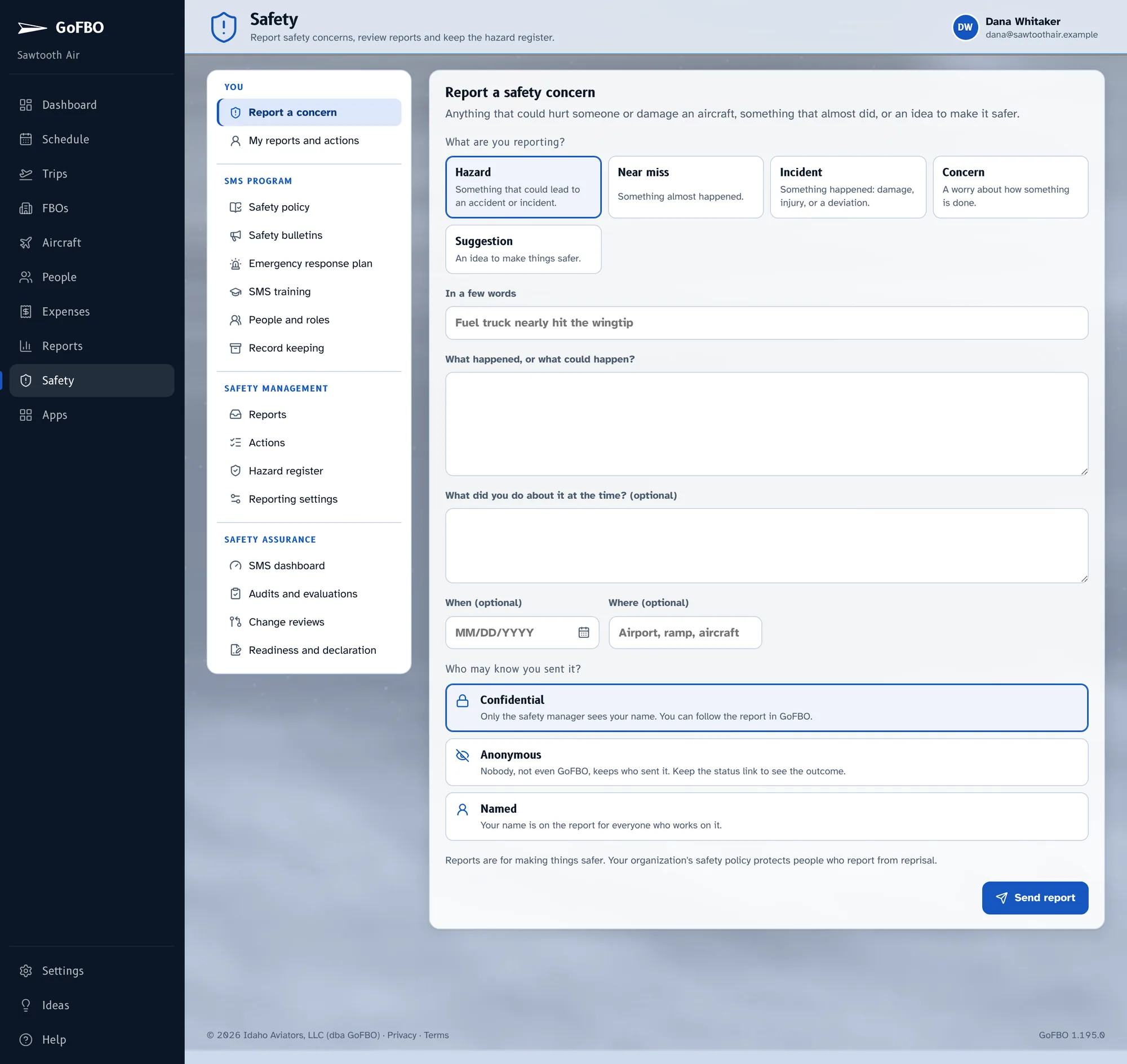
Anyone can report, safely
A short form in the app, or a link that needs no sign-in for line service, contractors and passengers.
- Named, confidential (only the safety manager sees the name) or anonymous
- Anonymous reports never store who sent them
- Reporters follow their report with a private status link
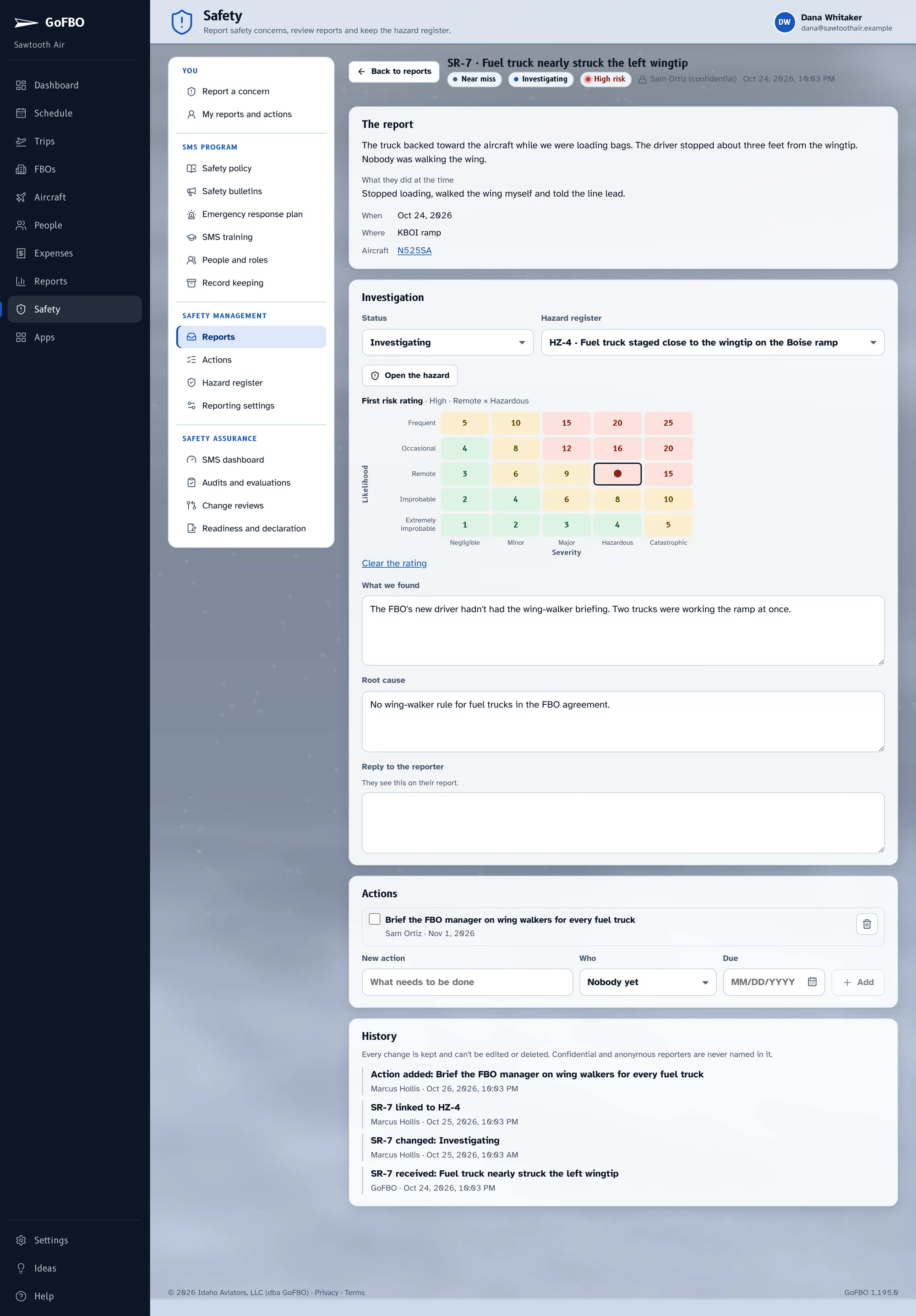
Investigate and fix it
The safety manager reviews each report, rates the risk, records what happened and why, and assigns corrective actions with owners and due dates. The reporter hears back.
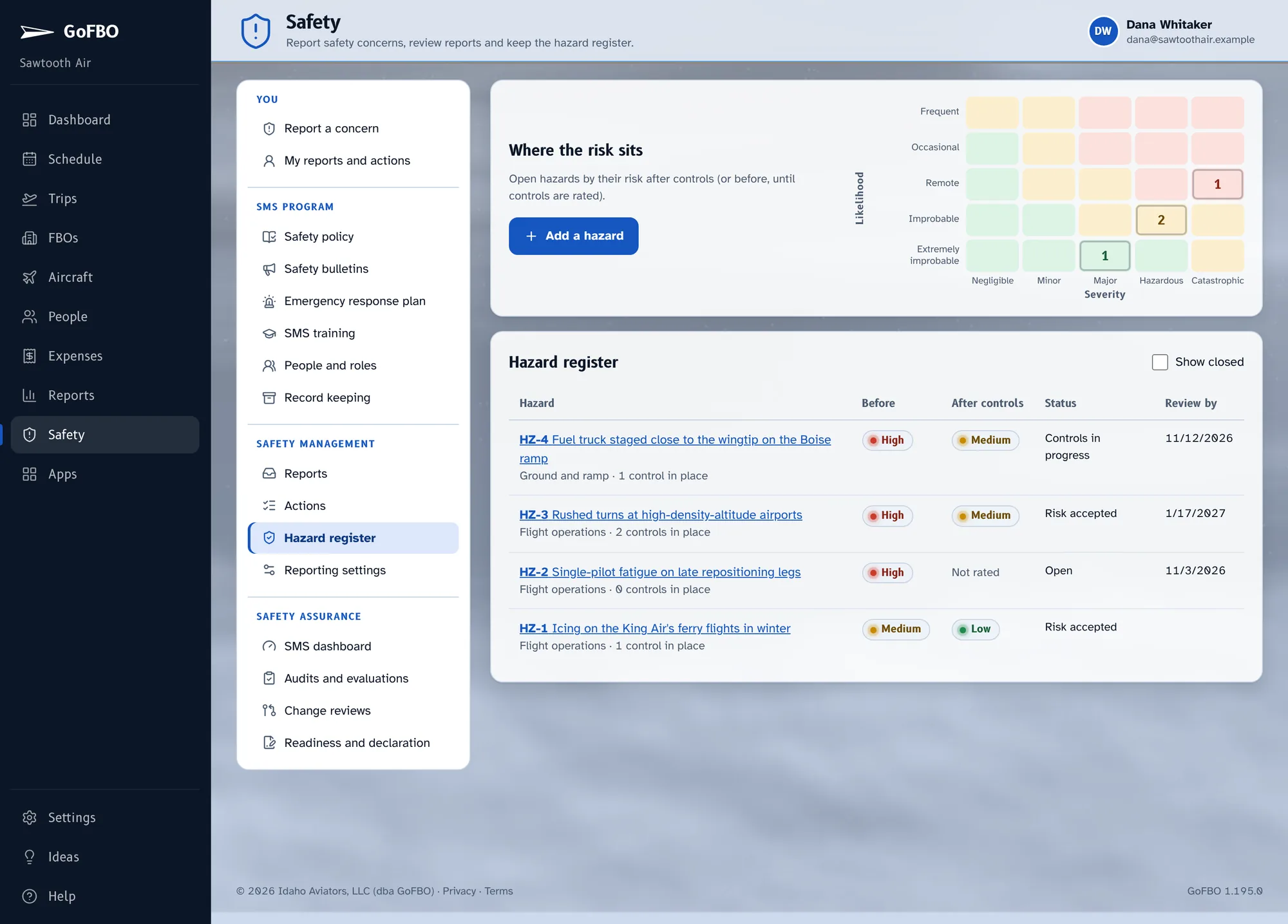
Keep the hazard register
Every hazard on a 5×5 matrix, rated before and after its controls. High risk that's left over needs an Admin to accept it, and every change is kept.
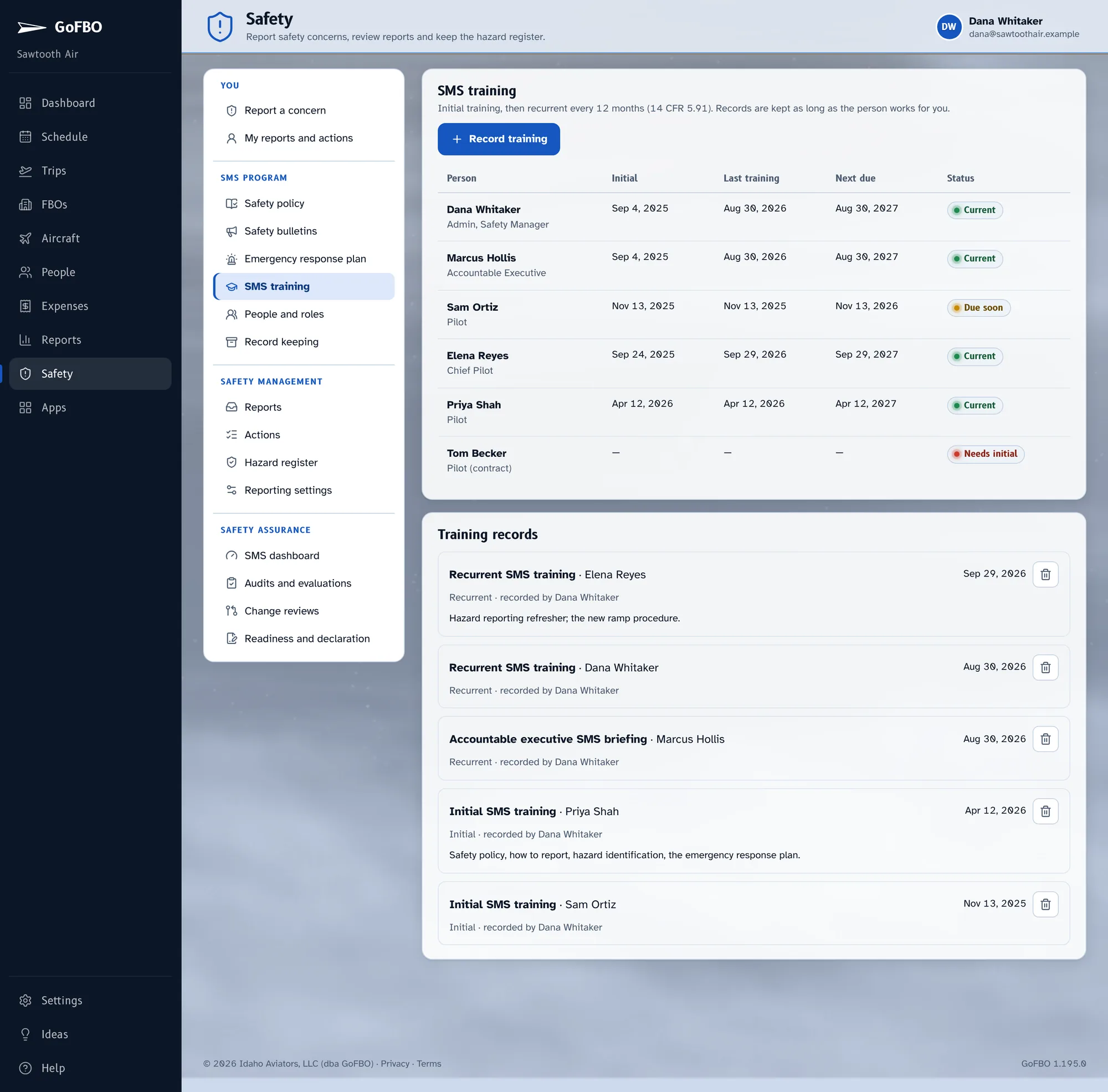
Train and tell everyone
SMS training records show who needs initial or recurrent training, and safety bulletins go to everyone by email or text with a record of who read them.
- Recurrent training every 12 months, or what you set
- Lessons learned linked to the report that started them
- The emergency response plan, one tap from the phone numbers
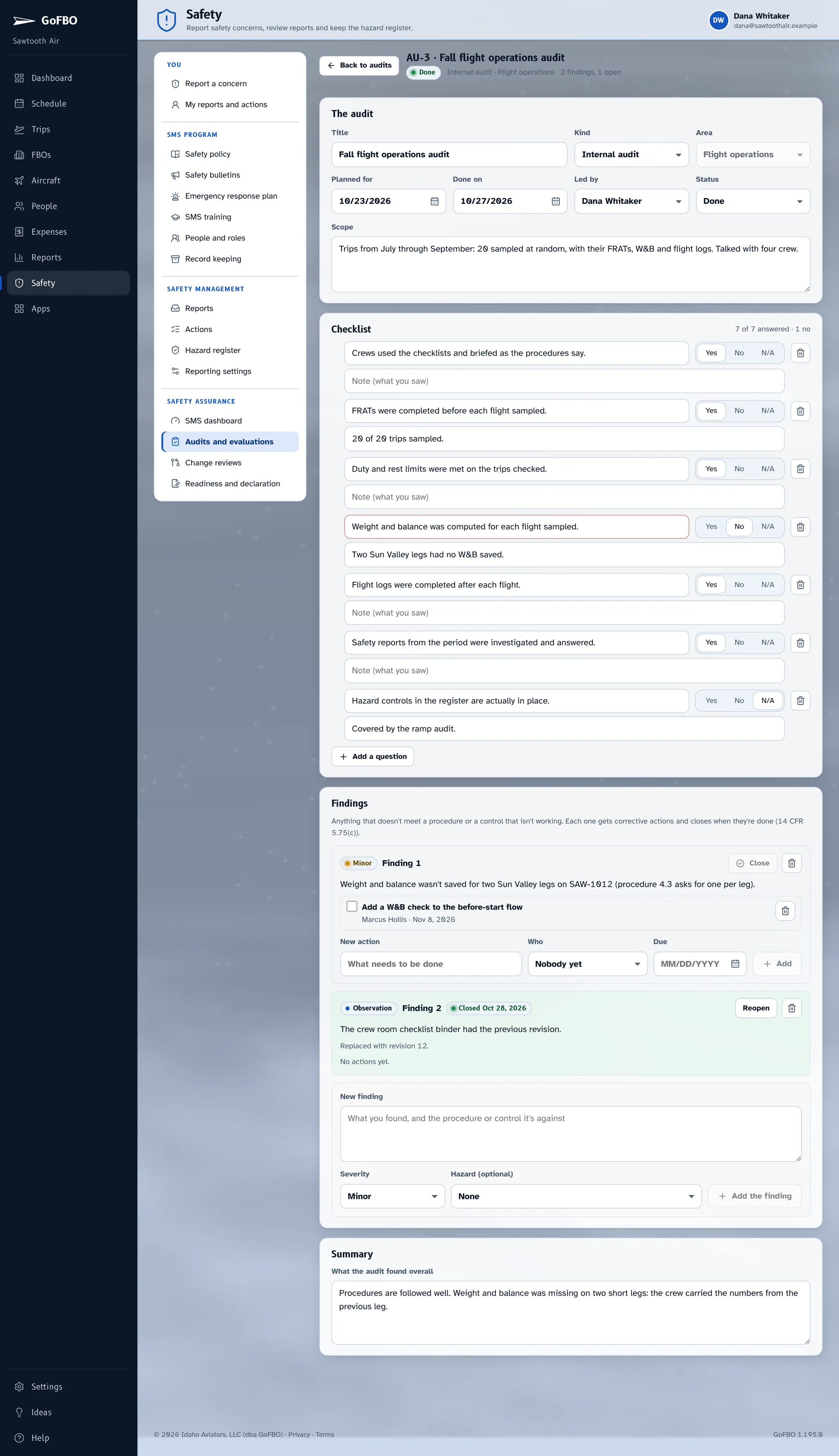
Audit it, and measure it
Plan internal audits from a checklist for each area, turn findings into corrective actions, and evaluate the SMS once a year. Safety objectives are measured from your own records.
- Checklists for flight operations, maintenance, ramp, dispatch and training
- A finding closes only when its actions are done
- Objectives for reports, incidents, overdue actions, training and more
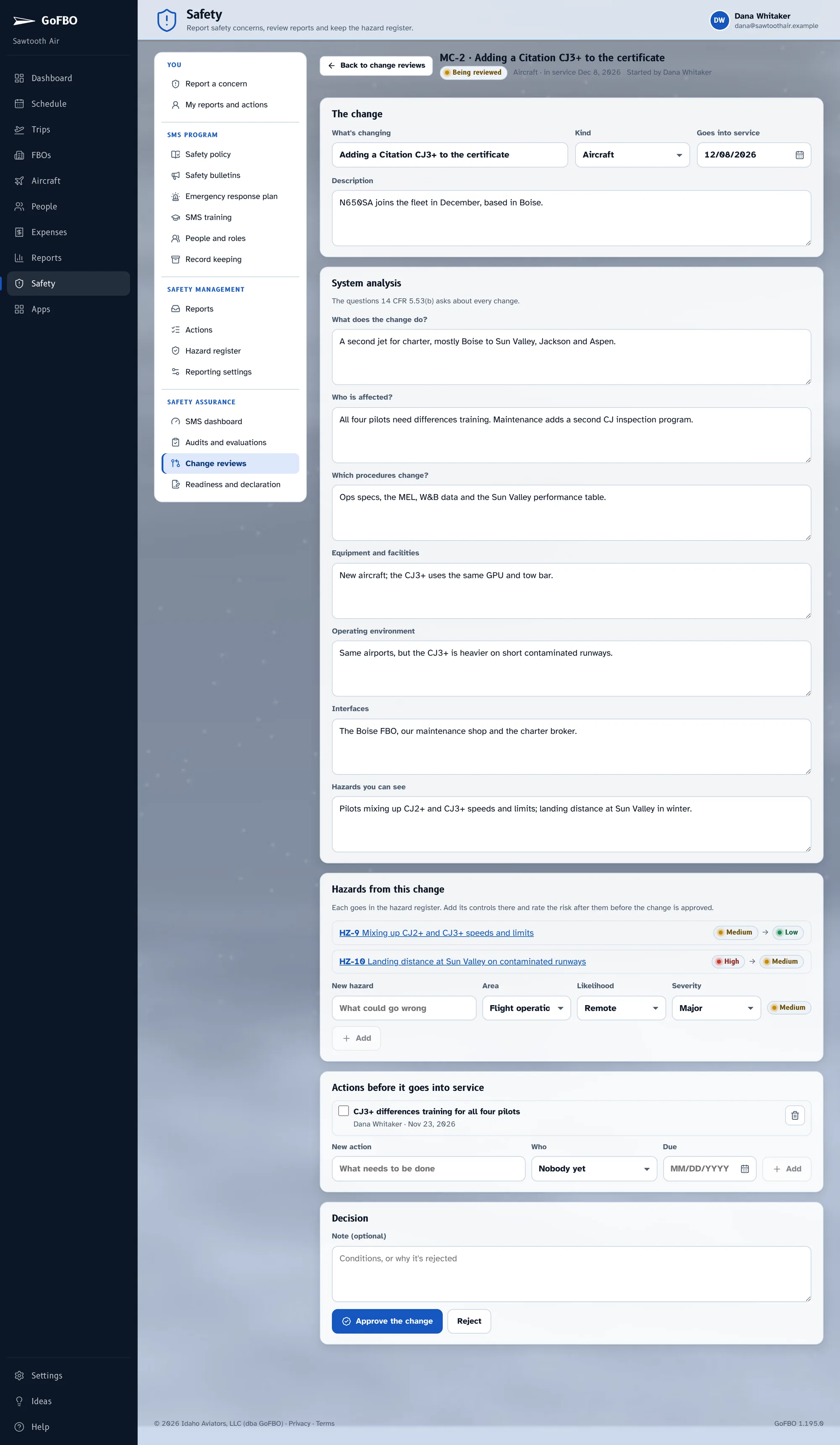
Review changes before they start
A new aircraft, base, route, procedure or key person goes through the system analysis Part 5 asks for, and its hazards go into the register before it's approved.
- High risk left after controls needs the accountable executive
- Actions before it goes into service, with owners and dates
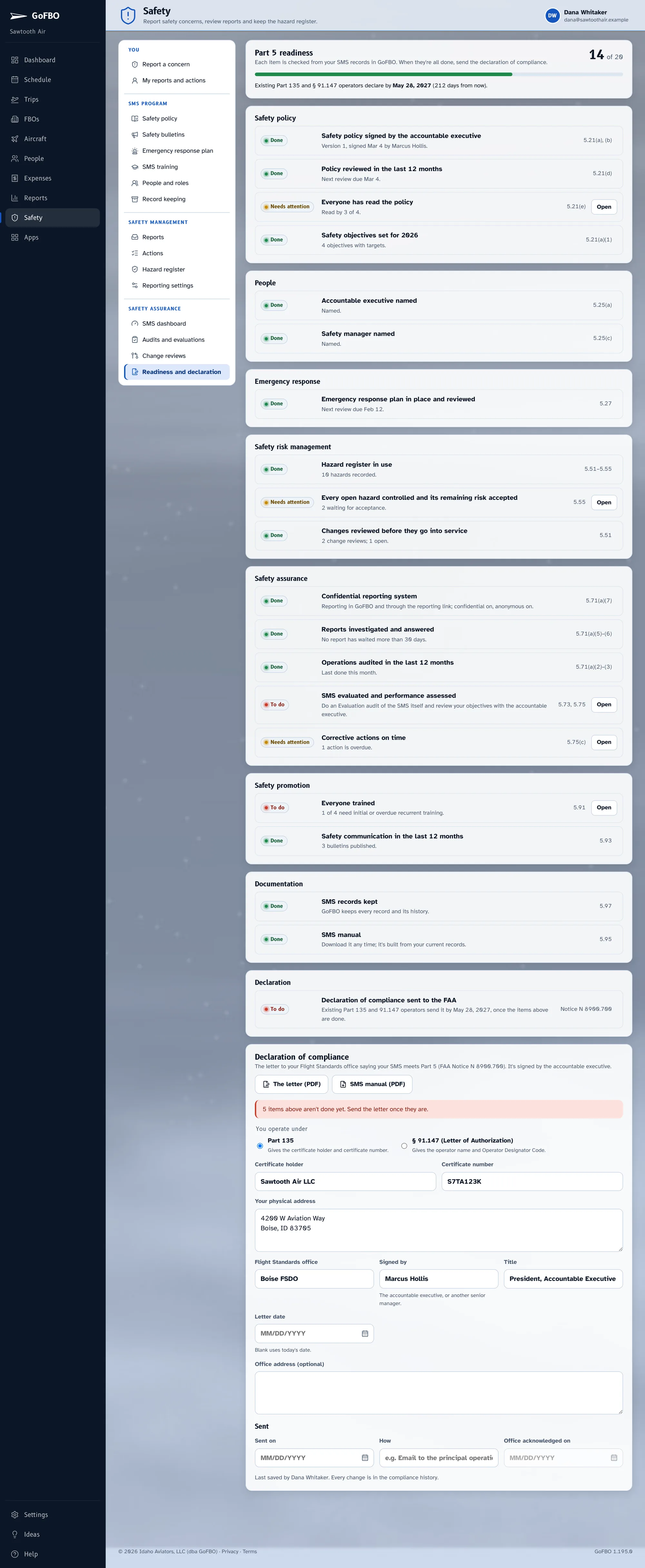
Declare compliance
A readiness check against every part of Part 5, built from your records, then the declaration of compliance letter for your Flight Standards office and an SMS manual PDF.
- Part 135 and § 91.147 letters, filled in from your certificate
- The SMS manual assembled from your policy, plan, registers and records
- Nothing is deleted automatically; every change is kept in a history
One pilot? It fits you too.
Part 5 expects less of a single-pilot operator, and GoFBO follows suit. Turn on Single-pilot operation and the parts 14 CFR 5.9 excuses step out of the way.
- You can be the accountable executive and the safety manager
- Reports are always named; no reporting link to manage
- The same hazard register, policy and records as a larger operator
Ready to declare.
Everything you need to send your declaration of compliance, from the records you keep every day.
SMS dashboard and objectives
Your safety objectives with the numbers behind them: reports, time to close, overdue actions, high-risk hazards, month by month.
Audits and evaluations
Internal audits with checklists, findings that become actions, and the yearly SMS evaluation.
Management of change
A new aircraft type, route or procedure goes through hazard identification before it starts.
Readiness and the letter
A readiness check against each part of Part 5, and the declaration of compliance letter for your Flight Standards office.
SMS manual
Your policy, roles, plan, registers and records assembled into an SMS manual PDF, always up to date.
Included with Part 135.
- Part of the Part 135 add-on, for every tail you license
- Part 91 flight departments can add it per aircraft
- Everyone in your organization can report; no per-person charge
Questions.
Do I need an SMS?
If you operate under Part 135, yes: 14 CFR Part 5 applies to Part 135 certificate holders, and you must have your SMS in place and send the FAA a declaration of compliance by May 28, 2027. Part 91 flight departments don't need one, but can run one the same way.
We're a single-pilot operator. Does this fit?
Yes. Turn on single-pilot operation and GoFBO follows the 14 CFR 5.9 exceptions: reports are always named, there's no reporting link, and you can hold every SMS role yourself.
Is an anonymous report really anonymous?
Yes. GoFBO never stores who sent an anonymous report, in the report, the history or the notices. Confidential reports keep the name, and only people with Safety management edit can see it.
Does GoFBO file anything with the FAA?
No. You declare compliance to the FAA yourself. GoFBO checks your SMS against Part 5, writes the declaration of compliance letter for your accountable executive to sign and send, and keeps the policy, records and history you'll show the inspector.
We already have an SMS manual. Can we use our own words?
Yes. The policy and the emergency response plan start from a draft so you're not facing a blank page, but every part can be replaced with the wording from your manual before your accountable executive signs it.
What does it cost?
It's included with the Part 135 add-on. Part 91 operators can add it on its own, per aircraft. See the plans for today's prices.
Built by pilots.
GoFBO is built by working pilots. The SMS is the one we wanted: in the same place as the trips, quick enough that people actually report, and kept the way an inspector expects to see it.
Start with your next trip.
Try GoFBO free for 30 days with every feature in the plan you pick. Set up your aircraft and crew in an afternoon and fly your next trip with it.
No card until the trial ends. If you don't add one, your account simply pauses, with everything saved.